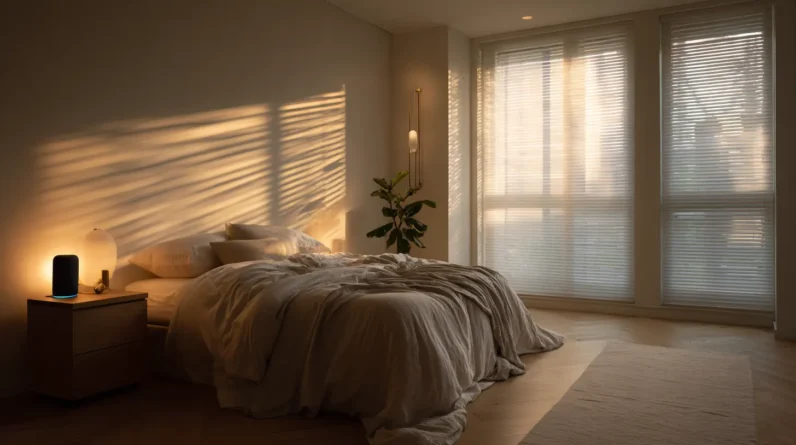




We’re building bedrooms where voice commands, synchronized lighting, and climate automation work seamlessly together. Smart speakers with Matter protocol support enable hands-free control while sensors monitor humidity and temperature for ideal sleep conditions. Motorized shades align with your circadian rhythm, automatically darkening at bedtime. Wearable trackers sync biometric data, feeding insights back into your system for continuous optimization. A central hub orchestrates everything through Thread and Zigbee, eliminating compatibility friction. Discover how these interconnected technologies transform your sleep environment into an intelligently responsive sanctuary.
Start With Voice Control and Smart Lighting
Because voice control and smart lighting form the foundation of any bedroom automation system, we’ll explore how these technologies work together to create a seamless user experience. Voice Assistants integrated with Smart Speakers enable hands-free command execution, allowing you to adjust lighting intensity, color temperature, and scheduling without physical interaction. We recommend selecting devices supporting open protocols like Matter for interoperability. Optimize placement by positioning Smart Speakers centrally to guarantee reliable voice recognition. Configure automation routines that align with circadian rhythms—dimming lights progressively at sunset, brightening at dawn. This synchronized approach minimizes friction in your daily workflow. We’ll show you how proper calibration of microphone sensitivity and acoustic tuning enhances responsiveness while reducing false activations, establishing a robust foundation for advanced bedroom integrations.
Create a Sleep-Optimized Climate System
While voice control and smart lighting establish automation fundamentals, we’ll now integrate intelligent climate management to create an environment that actively supports sleep quality. Smart thermostats enable precise temperature regulation, automatically adjusting setpoints based on circadian rhythms and external conditions. We’re leveraging advanced sensors that monitor humidity levels, ensuring ideal comfort throughout the night. Integrating air purification systems removes allergens and particulates, enhancing respiratory function during sleep. These devices communicate seamlessly through your existing ecosystem, learning preferences and adjusting proactively. We’ll configure scheduling protocols that initiate gradual temperature drops before bedtime, aligning with natural sleep onset mechanisms. This layered approach—combining temperature regulation with air quality management—transforms your bedroom into a scientifically-optimized sleep sanctuary. The result? Measurable improvements in sleep duration and quality through environmental precision.
Add Automated Window Treatments and Blackout Control
Complementing our climate optimization strategy, automated window treatments deliver precise light management—a critical component of circadian rhythm regulation that directly impacts melatonin production and sleep architecture. Motorized shades synchronized with your sleep schedule eliminate manual adjustment friction while maintaining consistent darkness levels throughout the night.
We’ll integrate solar screens that reduce heat gain during peak daylight hours, amplifying your climate system’s efficiency. These treatments respond to ambient light sensors, automatically adjusting opacity based on real-time conditions. Advanced scheduling algorithms align shade positioning with your chronotype, ensuring ideal darkness during sleep phases and gradual morning illumination that naturally facilitates wakefulness.
The result: a fully autonomous light environment that eliminates environmental variables disrupting sleep quality, creating conditions neuroscientifically optimized for restorative rest.
Integrate Sleep Tracking and Health Monitoring
To establish a data-driven foundation for continuous sleep optimization, we’ll deploy an exhaustive biometric monitoring ecosystem that captures physiological metrics throughout your rest cycle. Wearable fitness trackers sync seamlessly with bedside health monitors, transmitting real-time heart rate variability, REM sleep duration, and oxygen saturation levels to a centralized dashboard. We’re integrating advanced sleep architecture analysis that identifies fragmentation patterns and correlates them with environmental variables like temperature and humidity.
These connected devices generate actionable insights, enabling algorithmic adjustments to your bedroom’s climate control and lighting systems. By leveraging sleep-stage-specific data, we’re optimizing your recovery protocols with precision. The biometric feedback loop guarantees you’re not merely tracking sleep—you’re engineering it.
Choose a Hub That Connects Everything Seamlessly
All that biometric data flowing from your wearables and monitors needs a command center—a smart hub that orchestrates every device in your bedroom ecosystem without latency or compatibility friction. We’re talking about hub selection criteria that prioritize native protocol support: Thread, Matter, and Zigbee integration matter when you’re managing ten-plus connected devices simultaneously.
Your device integration strategy should emphasize centralized processing power. Evaluate hubs based on local processing capabilities—cloud dependency introduces unnecessary lag when you’re automating temperature adjustments or triggering sleep routines. We recommend selecting hubs that support your existing ecosystem rather than forcing proprietary lock-in.
Consider bandwidth capacity and redundancy features. A robust hub with mesh networking guarantees reliable communication across your bedroom’s connected infrastructure, maintaining seamless automation regardless of signal obstacles.
Conclusion
We’ve explored how orchestrating voice control, adaptive lighting, climate optimization, automated window treatments, and health monitoring creates a genuinely futuristic bedroom. By selecting a robust central hub—whether Matter-compatible or ecosystem-specific—we’re establishing an interconnected ecosystem that learns your sleep patterns and adjusts environmental variables in real time. These innovations don’t just enhance comfort; they represent the convergence of IoT, machine learning, and biometric integration transforming our personal spaces into responsive, intelligent environments.